
Food System

Food is being rewritten from the molecule up.

Precision fermentation, cellular agriculture, and vertical farming are changing the cost structure of food, medicines, and materials. The cost curves coming for your category are sharper than your strategy assumes.

The Food System Audit, powered by Janus by NavigateX, maps the disruption against your operation, your supply chain, and the assets you already own.

01 Food-as-Software

Biology starts behaving like software.

Most food, materials, and medicines have been made the same way for thousands of years: grow it, harvest it, refine it, ship it. Precision fermentation is a different kind of process. It treats biology as code.

Design

Scientists use AI and precision biology to unlock the genetic instructions for a target molecule. Often based on the DNA of existing sources (cow's milk protein, hen's egg protein, spider silk, collagen). Sometimes pioneering entirely new molecules not found in nature.

Build

The genetic instructions are inserted into a microbe (typically yeast), which is fed inexpensive feedstock (typically sugar). The microbe converts the feedstock into the target molecule at industrial scale, in a fermenter.

Scale

The target molecule is purified, formulated, and used downstream like any conventional ingredient. The digital nature of the process means every version is cheaper and better than the last. The cost curve compounds.

The reason this matters strategically is that biology starts behaving like software. Software cost curves have been the defining feature of every major industry disruption of the last 40 years. They are now coming for the food system.

02 You are already eating it

If "precision fermentation" sounds like science fiction, look in your medicine cabinet first.

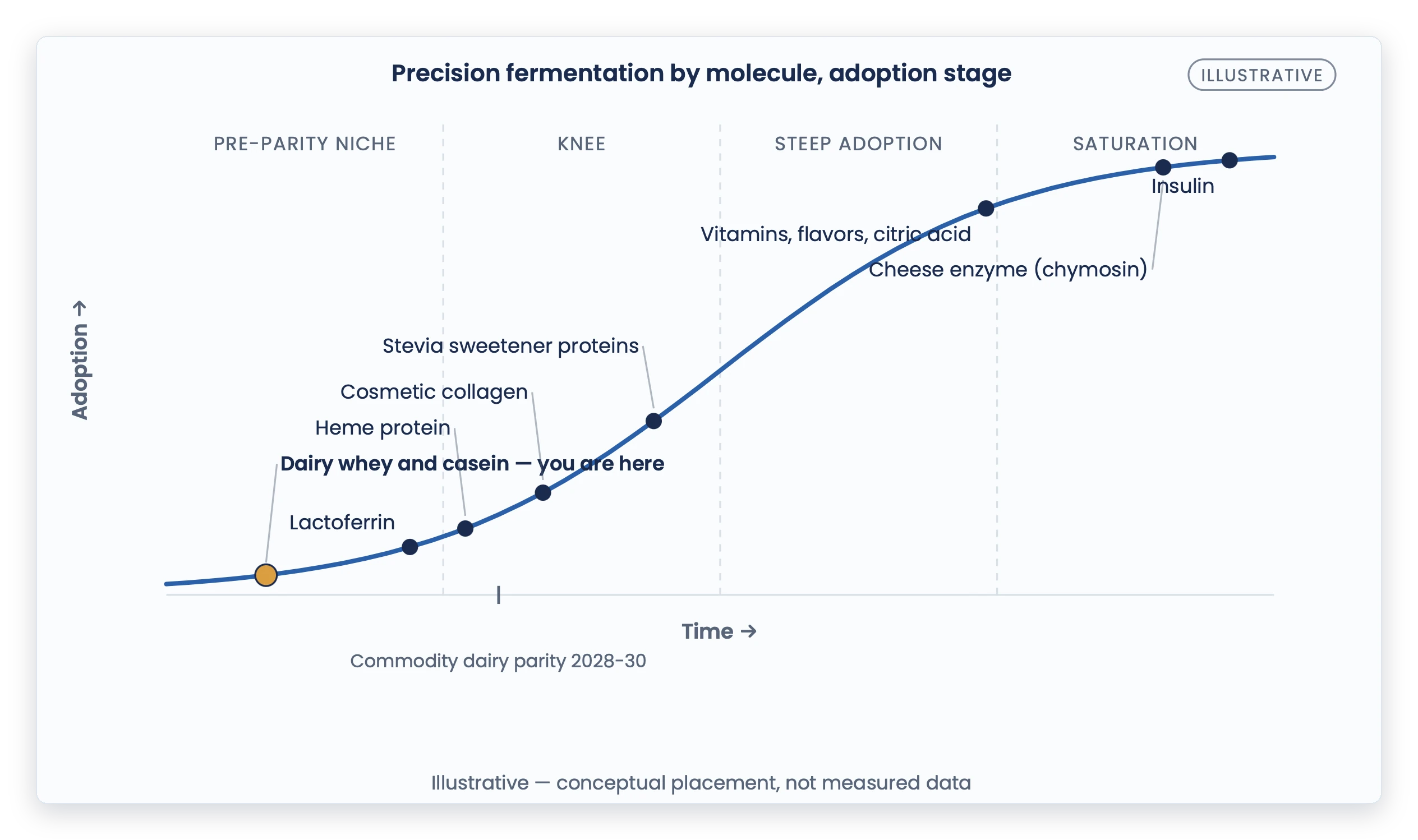
Most insulin produced in the world today is made by precision fermentation. So is a surprising amount of what you and your customers already consume. The technology is not new. It is just spreading.

Today

High-value molecules

Pharmaceuticals (including insulin and many antibiotics). Vitamins and supplements. Vaccines. Food enzymes (rennet for cheese, for example). Flavours, fragrances, and pigments. Specialty proteins for cosmetics and structural materials (collagen, keratin, spider silk, animal-free leather).

Within this decade

Core food staples

Animal-free dairy proteins (casein and whey, identical to the cow version) are at or near cost parity. Egg proteins follow. Ground meat. Pet food.

The categories that fall first will be the ones where the consumer experience is identical and the supply chain is simplest to swap.

Beyond

The long tail

Almost any complex organic molecule that biology produces can be produced by precision fermentation. The constraint is no longer "can we make it?". The constraint is "where does it land first?".

03 Why the economics are inevitable

Three forces compound to make this a question of when, not if.

The cost curve is approaching sugar

Precision fermentation costs follow software-like cost curves: as scale, learning, and process improvements compound, the unit cost falls relentlessly. The trajectory points at a cost approaching that of basic sugars (the dominant feedstock). When the input cost approaches the cost of sugar, the output cost approaches the cost of sugar plus a small processing margin.

Conventional animal protein cannot compete with that.

Stocks, not flows

Conventional food production is an opex-heavy extraction system. Every harvest requires a fresh flow of inputs: feed, fertilizer, water, fuel, labor.

Precision fermentation is the opposite. You build the production system once (capex), and it produces target molecules for decades with near-zero marginal cost. Paired with SWB Superpower (see the Energy page), the energy input itself approaches zero.

The economic substrate is no longer "ongoing inputs". It is "one-time infrastructure plus near-zero marginal cost".

Land, water, and inputs collapse

The same biological output requires a tiny fraction of the physical inputs.

Conventional dairy vs precision-fermented dairy protein

Input Conventional dairy Precision-fermented dairy protein
Land 100% 1%
Water 100% 5%
Fertilizer required none
Hormones / antibiotics often required none
Geographic constraint climate, terrain, animals a fermenter
Protein molecule the cow's identical to the cow's
Cost trajectory rising falling toward sugar

Identical molecules. Vastly cheaper. Producible anywhere there is electricity, water, and sugar.

04 What this does to the system around your business

The cost curve is one story. The system-level implications are another.

Industrial animal agriculture is being superseded

Once cost parity is reached, adoption accelerates fast. The transition is not gentle. The dairy, meat, and animal-feed sectors are facing the same kind of substitution dynamic that internal combustion engines are facing from electric drivetrains, or that coal-fired generation is facing from solar and wind. The conventional protein system is being superseded by a cheaper, faster, more sovereign substitute.

The strategic question for any operator in that system is timing, not direction.

Agricultural land is being freed at scale

Conservative estimates from RethinkX show over 80% of current agricultural land becoming available for other uses as the transition lands. That land will not sit idle. It will be repurposed for solar generation, ecological restoration, carbon sequestration, residential development, water management, or higher-value food production (vertical farming, specialty crops, biopharma feedstocks).
The most strategic operators will already be planning what their land does next.

WEF rated precision fermentation #1 for planetary health

External validation matters when you are taking this kind of analysis to a board. The strategic case for engaging with this transition is no longer a contrarian view. It is the mainstream view, recognized by every serious foresight institution.

Janus brings the analytical rigor your board needs to act on it.

05 What we bring to your question

We do not sell a fixed product. We model the question in front of you.

The food system is too big and too varied for a single off-the-shelf model. A dairy cooperative, a sovereign wealth fund, a palm oil major, and an agritech founder are all facing this disruption, but the question they need answered is different in each case.

So we do not sell a fixed product. We model the question that is in front of you. Examples we have helped clients work through.

Land use repositioning

If precision fermentation lands at cost parity by 2029, what is the highest-value use of the land currently committed to dairy, beef, soy, or palm? The answer is rarely "the same thing, more efficiently". It is usually a portfolio shift: some land to higher-value food, some to solar generation, some to ecological restoration, some held for optionality. The Audit models the alternatives against your specific land base.

Sovereign food security pathways

For a region or nation, what is the lowest-cost, lowest-risk path to feeding the population over a 20-year horizon, given the cost trajectories of precision fermentation, vertical farming, and conventional production? Where is local production strategically essential and where is import-tolerant?

The Audit produces the map.

Industrial repositioning

If your business operates dairy plants, slaughterhouses, animal feed processing, or related infrastructure, what is the most valuable pivot path? Some of your capital base translates directly (process control, supply chain relationships, brand). Some does not.

The Audit identifies what holds value and what needs to be transitioned.

Investment exposure

For a portfolio with exposure to agricultural inputs, land, livestock, or food retail, where is the stranded asset risk and where is the upside? The Audit produces the exposure map and the timing analysis.

Killer Combos around precision fermentation

Pairing a precision fermentation hub with SWB Superpower, desalination, data center waste heat, or a cellular agriculture facility produces dramatically better unit economics than any of them on their own.

The Audit models the combinations available to your geography and asset base.

The depth we bring to this work is grounded in the original 2019 RethinkX Rethinking Food & Agriculture report, significant precision fermentation-related modeling we have developed over the years, and direct engagement with regions and operators thinking about this transition.

06 Same physics. Three different plays.

What you do with this disruption depends on what you operate.

Three patterns show up most often.

Your land is your asset. What you grow on it is your business model. The two are not the same thing.

Today they are tightly coupled (dairy farmers run dairy farms, palm growers run palm plantations). Precision fermentation, vertical farming, and cellular agriculture decouple them. The land remains valuable. The optimal use of that land is changing. The strategic move is to think portfolio: a mix of the highest-value food production, energy generation, ecological assets, optionality, and the brand and supply-chain capabilities that translate across categories. The Food System Audit produces that portfolio map and the transition sequence.

Bring food production home, regardless of climate or land area.

Food security is the most underappreciated form of national resilience. A region that depends on imported protein and grain is a region whose strategic options shrink every time global supply chains shake. The transition to precision fermentation and local biological production is a structural opportunity to bring food production home, regardless of climate, land area, or legacy industrial capacity.

For developing economies in particular, the leapfrog opportunity is real: legacy industrial food infrastructure is expensive to build and slow to defend. Precision fermentation and vertical farming are buildable now, in any climate, on small land footprints, with predictable energy inputs. The Food System Audit maps the path.

Stranded asset risk in agricultural exposure is rising. The trajectory is not gentle.

Conventional dairy, beef, soy, palm, and feed are facing the same kind of substitution dynamic that fossil fuels are facing. The strategic question is not whether to recognize it. It is when, and how. The Food System Audit produces the exposure map, the timing analysis, and the upside positioning.

07 What you need to play

The Silicon Valley of this disruption has not been determined yet.

Precision fermentation is in the early stages of scaling, like the internet was in the early 1990s. It is up for grabs by anyone bold enough, prepared enough, and patient enough to claim it. Here is what shows up on the asset list.

Physical

Reliable energy (ideally clean and abundant). Clean water. Land or industrial space for the fermentation infrastructure. An existing or buildable supply chain to sell into.

Human

Food science talent (or the ability to attract it). Operational capability to run continuous biological production. Brand and customer relationships that translate to new product categories.

Capital

Patient capital, ideally with partners who understand the time horizons of biological infrastructure. Willingness to balance capex investment now against opex savings over decades.

Strategic

The right mindset: this is not a crop or a herd, it is a system. Appetite for experimentation. The willingness to think in 10 to 20 year horizons. The patience to build a position before the market understands what is happening.

08 The Food System Audit

The most flexible of our three sector Audits.

The Audit is the managed engagement that takes your specific question and gives you a strategic answer your board can act on.

The Food System Audit is the most flexible of our three sector Audits because the strategic questions span a wider range. A regional government asking about food security has different inputs and different outputs from a dairy cooperative asking about portfolio repositioning. The shape of the Audit adapts. The discipline behind it does not.

What you bring

Your specific question. The assets and capabilities you operate or own. The geographic and operational context that constrains your decisions. The strategic horizon you are planning against. Any business plans, capital plans, or stakeholder positions that shape what your decision space looks like.

What we do

Configure the Janus environment for your situation. Apply the precision fermentation, cellular agriculture, and vertical farming cost curves to your specific operation, geography, or portfolio. Model the scenarios that fall out of your question. Identify the Killer Combo opportunities visible from your asset base. Stress-test the answer against the assumptions you are most worried about.

What you leave with

A strategic recommendation grounded in the modeling, a scenario map your team can keep running, and a roadmap of next moves with the sequencing that matters most. Plus the Janus environment configured for your situation, so the analysis continues to live and evolve.

09 Provenance

The thinking that named this disruption.

RethinkX originated the term "precision fermentation" in their 2019 Rethinking Food & Agriculture report. That report has been the foundational text on this disruption for the better part of a decade. The NavigateX team includes several contributors to that original RethinkX research, and our analytical capability builds directly on that foundation while extending it into strategic, commercial, and audit-led applications.

Adam Dorr leads RethinkX today. Richard Gill, NavigateX's founder, was previously CEO of RethinkX.

The result is a depth of provenance, methodology, and analytical capability that very few advisors can offer.

11 Start with a Food System Audit

Every engagement begins with a conversation.

We will help you scope a Food System Audit that fits your operation, your question, and your strategic horizon.

Or jump to another part of NavigateX
30 minutes. No fee. No obligation.