

Workforce

Stop hiring for 2025. Start mapping for 2028 and beyond.

The Great Labor Decoupling is closer than your workforce plan assumes. Physical labor is shifting from high-risk Opex (people) to high-yield Capex (silicon and steel).

Janus by NavigateX shows you exactly which roles in your specific workforce are crossing first.

01 Three phases of the transformation

This is not job loss. It is job evolution at exponential speed.

The conversation about humanoid robotics defaults to "how many jobs will we lose?". That framing makes the transformation look like a wave of redundancy. It isn't. What is actually happening is a rapid, deliberate decomposition of work, and the organizations that see it that way get to design the next decade of their workforce rather than absorb it.

Our Future of Work Framework describes the transformation in three phases. The phases are sequential. The motion through them is exponential.

Phase 1 illustration: a humanoid robot welding under a human operator reviewing data in AR
Phase 1

Augmentation

Robots take the repetitive, dangerous, and physically demanding tasks. Humans take coordination, judgment, creativity, and responsibility for outcomes. One supervisor manages a fleet of robots, lifting productive capacity 10x without lifting headcount.

This is where every workforce should be planning right now.

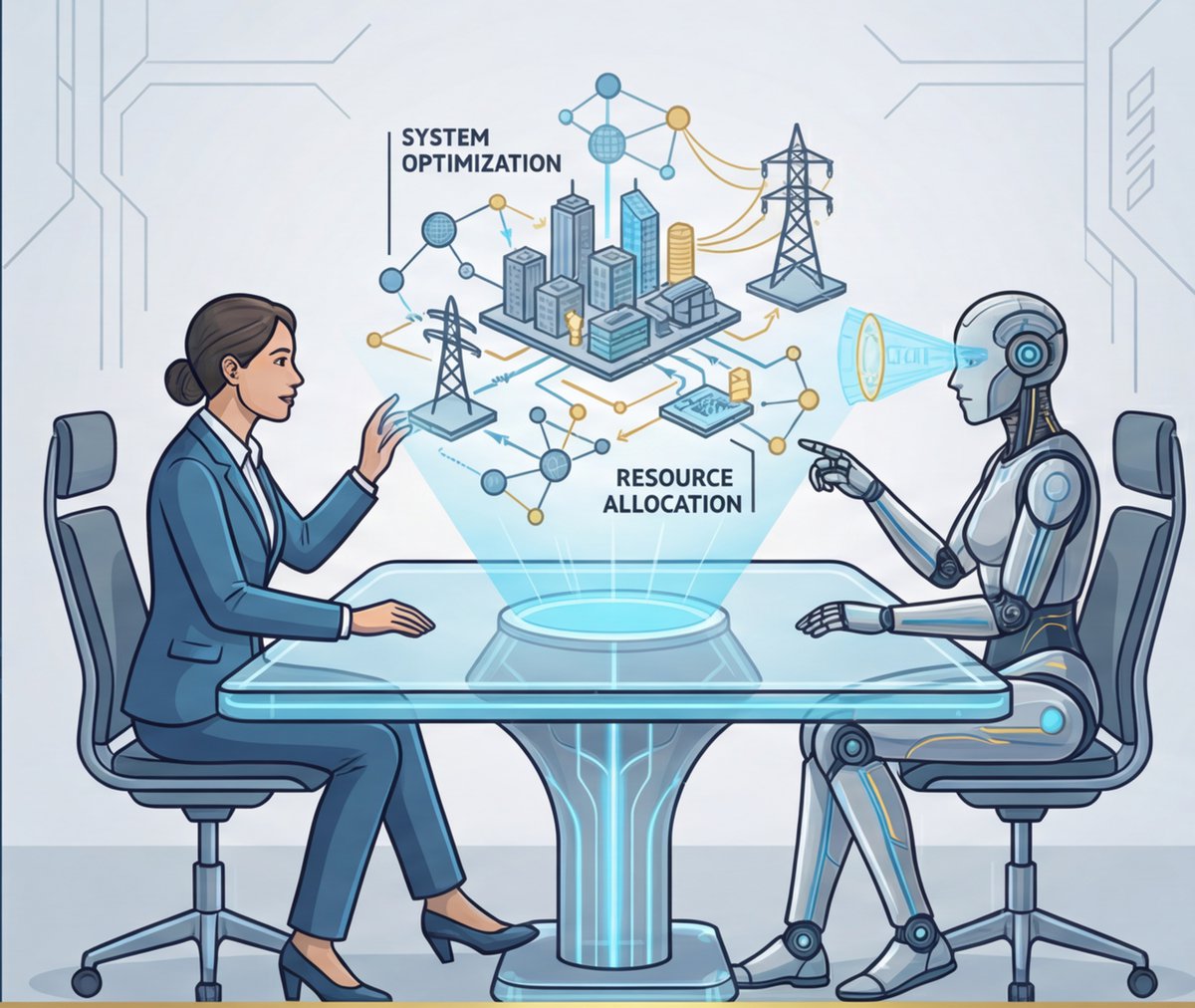
Phase 2 illustration: a human and a humanoid robot collaborating at a holographic planning table
Phase 2

Parity

Robots reach functional parity with humans across most cognitive and physical tasks. The strategic question shifts from "what should robots do for us?" to "what should humans uniquely do?". Few organizations are ready to have this conversation honestly. Janus is the engine that makes it possible.

Phase 3 illustration: drones and robots running automated production while humans enjoy creative leisure in nature
Phase 3

Replacement

The full automation of the production system. The end of the era where human survival is yoked to selling our time.

The economic implications are profound and outside the scope of a single audit, but Janus tracks them so your strategy does not get blindsided by them.

The organizations that win this decade will be those that unbundle work deliberately, instead of letting it happen to them. To do that deliberately, you need a model of work that goes below the level of the job.

02 Capabilities, not jobs

The unit of value is not the job. It is the task.

Most automation analysis treats your workforce as a single P&L line item. The reason it gets the answer wrong is that it never goes below the level of the job. We do.

What do we mean by a "job"? In the most familiar sense it's the popular name someone uses for what they do. "I'm a welder." Behind that name sits a role: the formal occupational category from a standard taxonomy of nearly 900. Each role is performed by carrying out specific tasks, the discrete activities that fill the day. And each task draws on a combination of underlying physical and cognitive capabilities. We map 160+ of them in our model.

So the question "will a robot replace this job?" has no usable answer, because jobs do not decompose evenly. The question we ask instead is "which of the 12 to 20 capabilities this role's tasks rely on can a 2026 humanoid match today, and which can it match within 24 months?". That question has an answer. And the answer is what changes your hiring plan.

That granularity is the difference between a strategic plan and a guess.

Where humanoids already exceed human capability

Examples from the 2026 model, comparing the level of capability required by typical physical roles with the level a 2026-generation humanoid can deliver. Both columns use a measured 0-100 scale.

Capability Human requirement 2026 humanoid The implication
Static strength (lifting 50lbs+)4581.4 (surplus)Zero muscle fatigue. 100% capacity at hour 1 or hour 20.
Manual dexterity (assembly)4584.0 (surplus)Sub-millimetre precision. Tactile sensors exceed human sensitivity.
Near vision (inspection)4695.0 (surplus)Multi-spectral and AI-vision see what human eyes miss.
Bio-risk resilienceVaries (high risk)TotalOperates in extreme heat, cold, and toxic zones without PPE.

The point of the table is not the specific numbers. It is the structural reality: in many of the most expensive, dangerous, and high-turnover physical roles, the question is no longer "if". It is "when, and which capabilities first".

03 Where humans still lead

And probably always will.

The honest answer to "what are humans uniquely good at?" is also the answer to "where should you be investing in your people right now?". We map the cognitive gaps where 2026-generation humanoids fail, and where your team's capability needs to grow to manage the workforce of the next decade.

Where 2026 humanoids fail

The same model that quantifies humanoid surplus quantifies humanoid deficit.

Work activity Human level 2026 humanoid The strategy
Coaching others57 (high)18 (fail)Human-led: mentorship and culture
Creative thinking57 (high)28 (fail)Human-led: improvised problem-solving
Complex problem-solving in chaotic environments56 (high)35 (low)Human-led: navigating site reality

Where your people become indispensable

Your humans are not your replacement target. They are your orchestration layer. The strategic move is to lift them out of the work robots will do better, and into the work robots cannot do at all. Judgment. Responsibility. Wisdom. Coaching the team. Setting the direction. Holding the line on what matters.

The framing we operate from: we don't just tell you the robots are coming. We show you exactly which 20% of your tasks are 90% ready today.

04 The Silicon Shield

Hedging the uninsurable.

Productivity is the headline argument for humanoid robotics. The risk arithmetic is the bigger one for most industrial operators.

Under modern occupational safety frameworks and duty-of-care legislation, a growing class of core industrial risks have become Naked Risks: risks that are increasingly difficult to insure, mitigate through PPE, or compliance your way out of. They are uninsurable not because no insurer will write the policy, but because the premiums, fines, and reputational consequences of a single bad incident now exceed any reasonable cover.

Eliminating the human from the hazard zone changes that calculus structurally.

Level 1 elimination, not Level 4 PPE

Under the Hierarchy of Controls, PPE is the weakest mitigation. Elimination is the strongest. A robot in a hazard zone instead of a human is the only Level 1 control available to most operations.

Insurance deflation

Experience-rated workers' compensation premiums fall when you remove human injury data points from high-hazard operational zones. Secondary injury costs (downtime, retraining, settlements) fall to zero where humans are not present to be injured.

Zero-compliance overhead

Robots do not need life-safety infrastructure, environmental air filtration, mandatory thermal-stress breaks, or psychological safety programs around traumatic events.

The cost of compliance falls with the cost of the people you no longer need in the danger zone.

The strategic logic

You cannot insure against a regulatory fine. You can prevent an incident. The Silicon Shield turns dangerous work into routine activities, and routine activities into structurally lower opex.

05 The crossover, in real numbers

The Scarcity Tax disappears for organizations that prepare.

Most workforce planning assumes labor costs rise on a predictable curve. They do not. What is rising is the Scarcity Tax: the premium you are paying right now to access labor that is scarce, aging, and increasingly mismatched to the work you actually need done.

Within 36 months, that tax disappears for organizations that have prepared their infrastructure. For organizations that have not, it accelerates.

2.17
By 2030
One humanoid does the work of 2.17 humans. Not by being a faster version of a human. By working 24 hours without breaks, fatigue, sick leave, training cycles, or scheduling. The unit economics shift before the unit count does.
8.7
By 2035
One humanoid does the work of 8.7 humans. The same ratio, projected forward on observed humanoid capability curves. Compounding factors: improving dexterity, falling unit cost, AI-driven software improvements, and the build-out of supporting infrastructure.
The Labor Multiplier

The strategic prize is not "replace your workforce." It is what we call the Labor Multiplier: transition your best people from individual contributors to Fleet Managers, supervising a fleet of robots that handles the work below their judgment layer. The result is 10x operational output without adding a single person to the payroll.

This is what "Stop hiring for 2025" actually means. Not freeze headcount. Reshape it.

06 Same physics. Three different plays.

What you do with the model depends on what kind of leader you are.

Three patterns show up most often.

Stop hiring for roles that will be 90% automatable in 24 months.

The hiring decisions you are making this quarter depend on where the crossover lands for your specific roles.

A Humanoid Labor Audit gives you the Role Vulnerability Map: prioritized, with timing, so you can stop hiring for roles that will be 90% automatable in 24 months, and start hiring for the Fleet Manager layer that is going to define the next decade of your operating model.

Lead with Naked Risk reduction and Silicon Shield economics.

The dangerous, hazardous, high-turnover roles are where the cost case is sharpest and the strategic case is fastest.

A Humanoid Labor Audit identifies the roles where Level 1 elimination is operationally feasible today and where the insurance deflation case is sharpest.

From inflationary wage opex to depreciating asset capex.

The shift from inflationary wage opex (rising, hard to insure, scarce labor) to depreciating asset capex (predictable, financeable, improving over time) is one of the biggest single balance sheet stories of this decade.

A Humanoid Labor Audit produces the CapEx Transition Roadmap that makes this financeable.

07 Inside the Humanoid Labor Audit

A 4-week deep dive into your operational resilience.

The Audit is not a "wait and see" report. It is a 4-week deep dive into your operational resilience, configured to your workforce, your operations, and your strategic horizon. You receive three specific deliverables.

The Role Vulnerability Map

A prioritized list of the roles in your workforce facing the most immediate economic crossover, with the specific capabilities driving each crossover. Includes timing, confidence levels, and the order in which to act.

The Robot-Human Teaming (RHT) Interface

A blueprint for how your supervisors will manage a future robotic fleet. Reporting structures, decision rights, escalation paths, training requirements, and the operating model that takes you from "people doing the work" to "people directing the work that gets done".

The CapEx Transition Roadmap

A financial model that shifts your workforce budget from inflationary wage pressure to asset-driven technological deflation.

Includes the year-by-year capex schedule, the corresponding opex reduction, the financing structure, and the cumulative balance sheet impact over the planning horizon.

The future of work is not toil. It is Intent.

08 Powered by Janus

Deterministic logic, not an LLM that hallucinates.

Every recommendation in your Audit is grounded in Janus, our disruption modeling engine. Deterministic logic, auditable analysis, not an LLM that hallucinates when it does not know.

Janus is what turns the Labor Multiplier from a thesis into a financeable plan, what lets you stress-test the crossover dates against your own assumptions, and what gives your team a live capability for running scenarios long after the Audit closes.

How Janus works →
10 Start with a Humanoid Labor Audit

Every engagement begins with a conversation.

We will help you scope a Humanoid Labor Audit that fits your operating context, your workforce composition, and your strategic horizon.

Or jump to another part of NavigateX
30 minutes. No fee. No obligation.