Janus by NavigateX

$100 trillion is being bet on a world that no longer exists.

Janus is the strategic GPS for what comes next. It maps where today's capital plans collide with the physics of disruption, and where the new value is being created.

30 minutes. No fee. No obligation.
01 The strategic GPS

The way navigation systems work, applied to strategy.

Most leaders are planning the next decade with linear assumptions and AI tools that hallucinate. Janus does neither.

It works the way navigation systems work: triangulating where you are, where the terrain is moving, and the lowest-cost path through it. Three capabilities define how.

Collision Detection

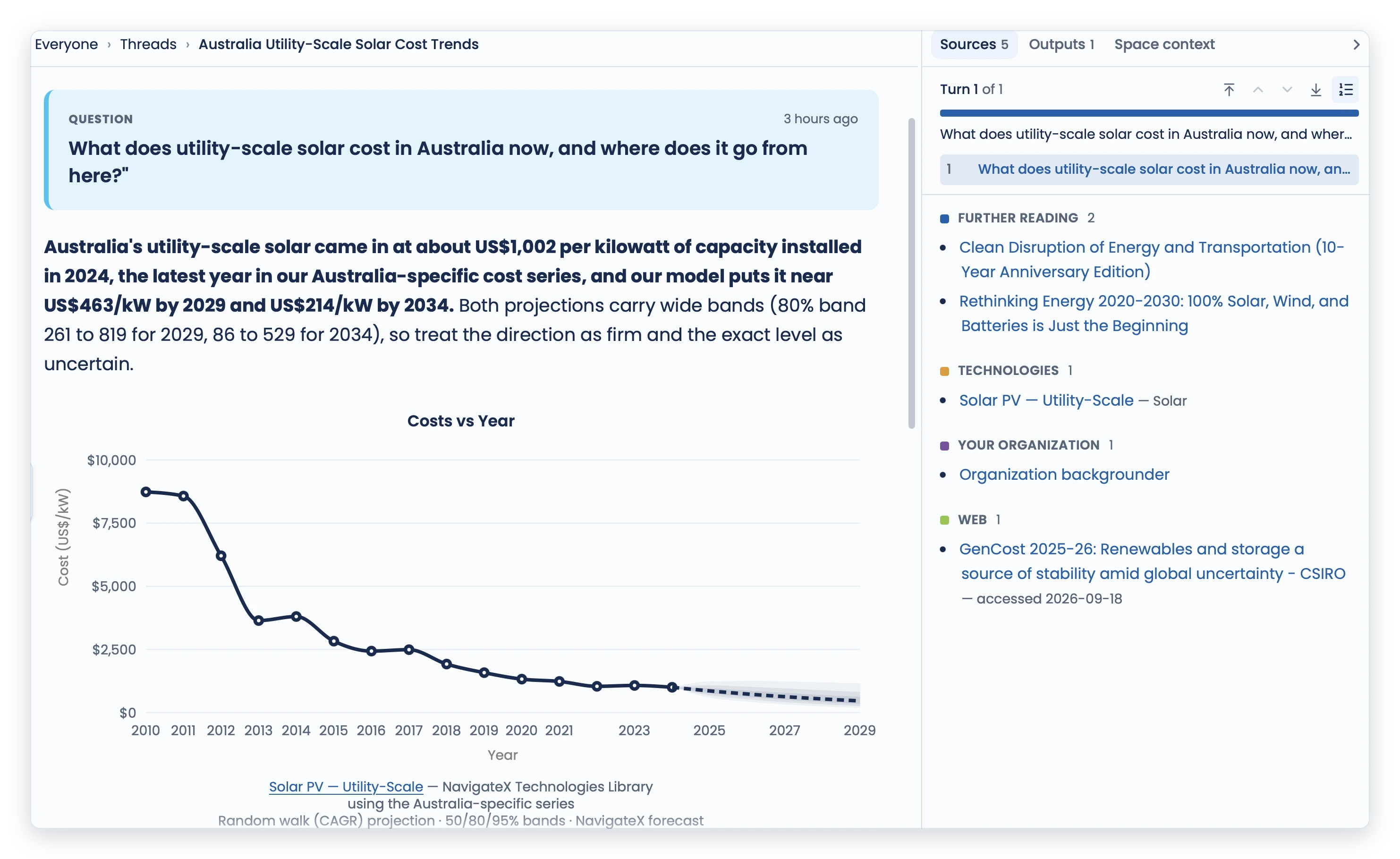
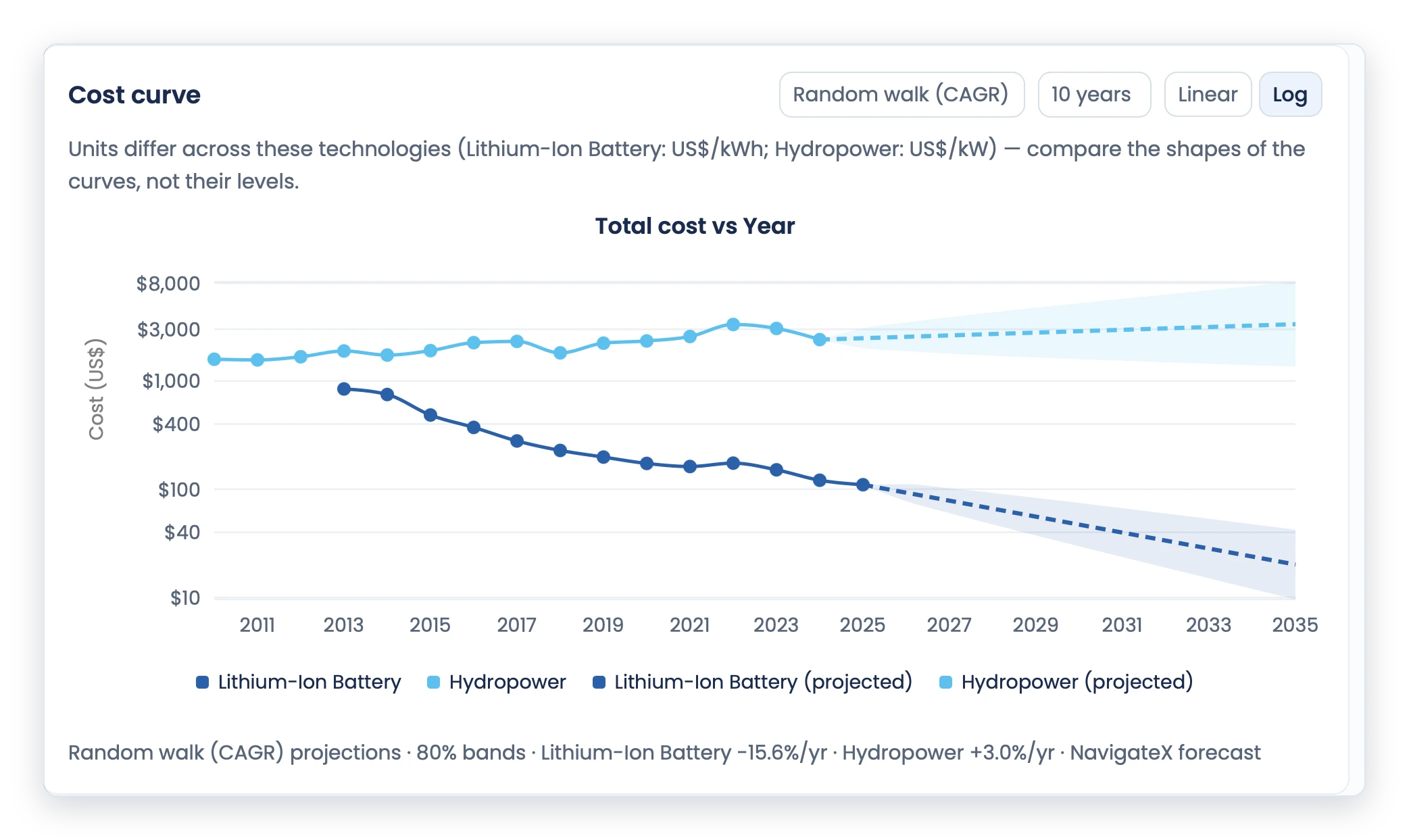
We identify where your current capital plans collide with the cost curves of the technologies that will replace them. The crossover dates are not opinions. They are mathematics.

The Stellar Path

We compute the specific sequence of strategic moves that captures the disruption upside, instead of being captured by it. Sequencing, dependencies, trade-offs, ROI.

Logic, not chat

Janus has a conversational interface. The engine underneath is deterministic: precision logic, mathematics, and audited algorithms, not the training data of an LLM. AI enhances the analysis. It does not invent it.

02 Why we see what others miss

The future is not a slightly faster version of the past.

Most strategic frameworks assume it is. That is the single most expensive assumption an institution can make right now.

We call our approach Disruption Economics. It rests on three observations conventional analysis still does not price in.

Technology adopts on S-curves, not straight lines

The "knee of the curve" is the point at which adoption moves from 10% to 90% inside a single decade. Linear projections miss it entirely. Janus models it.

Sectors do not exist in isolation

Energy disruption changes the cost of food. Cheaper food changes the case for land. Cheaper land changes the politics of agriculture.

We model these convergence mechanics across all five Stellar sectors: energy, transport, food, materials, and labor.

The collisions trigger a phase change, not a transition

When multiple disruptions converge, the result is not a slightly cheaper version of the old system. It is a structurally new system, with different economics, different winners, and different risks.

A new lexicon
Conventional view Disruption Economics Why the shift
Linear thinking Exponential thinking Adoption follows S-curves, not straight lines.
Sector focus Systems focus One disruption resets the economics of every other sector.
Scarcity Superabundance Near-zero marginal cost ends the logic of scarcity.
Transition Transformation Convergence produces a new system, not a faster one.
Job losses Ending human toil Automation removes dangerous, repetitive work humans never wanted.
03 Why Janus does not hallucinate

Deterministic at the core. AI on top, never in the foundation.

The same year AI tools became indispensable, they also became famous for confidently inventing things that are not true. That is a feature most boards cannot accept in a system that influences capital allocation.

Janus is built differently. The core engine is deterministic: precision logic, mathematics, and well-understood scientific principles that can be audited, tested, and explained. AI is layered on top, not used to substitute for the foundation. Three principles govern how this works.

Deterministic logic, not generative output

Disruption Economics is modeled in code humans can read and audit. The cost curves, system dynamics, and convergence mechanics are not the output of a language model. They are the output of a calculation.

The reasoning is traceable from input to result.

Structured knowledge graphs, not training-data soup

Where AI is used (for example, to evaluate new technology data and link it to existing models), the results land in structured, auditable knowledge graphs.

Every entry carries a confidence rating. Human supervision is in the loop to continuously improve the evaluation criteria.

AI enhances. AI does not invent.

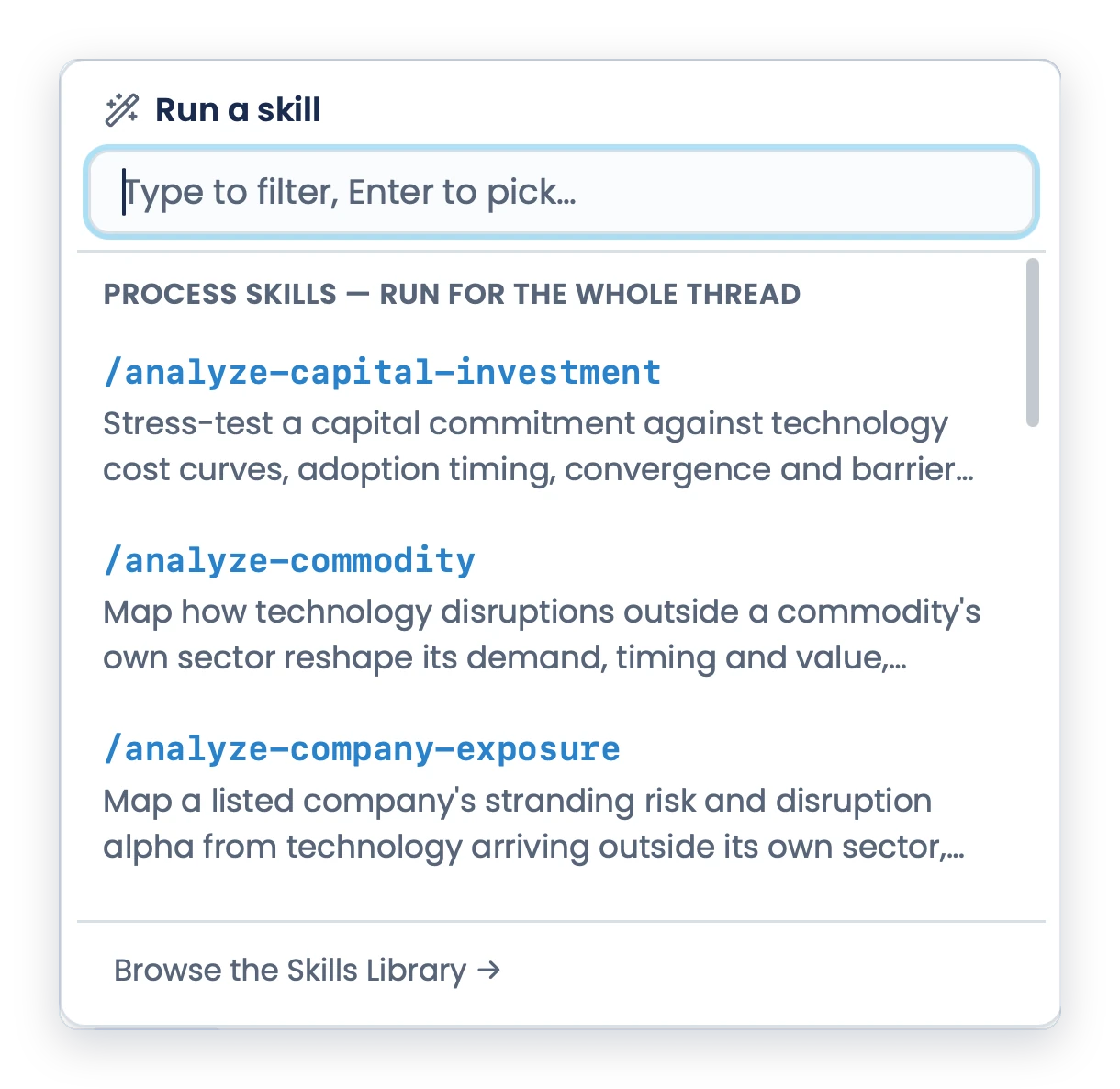
Where AI helps users interrogate the analysis (querying scenarios, exploring "what if" questions), it operates on top of validated model outputs, with explicit rules and feedback loops. Users always know what came from the deterministic core and what came from the AI layer.

04 Built for humans and for agents

Two surfaces. One engine.

Janus has two surfaces. They share the same engine and serve different kinds of users.

For humans

The Janus Navigator

The immersive, board-ready interface where strategy teams and senior leaders explore scenarios, build cases, and surface the moments that drive board-level consensus. Designed to make the invisible forces of disruption visible and urgent, so the conversation in the room can finally move.

For agents

The Janus API

An increasing number of clients are building their own AI ecosystems. We are ready for that. Janus exposes its core logic through an API and a Model Context Protocol (MCP) gateway, so your internal AI tools and agentic workflows can plug straight in and see what our engine sees. Talk to us about integrating your agents.

05 Sectors today and tomorrow

Sector-aware. Calibrated to specific cost curves.

Janus models the specific cost curves, technologies, and convergence dynamics of the sectors that are transforming the economy. Three sectors are live or in active deployment today. Others are on the development roadmap.

Live today

Energy

Sovereign, resilient, near-zero marginal cost energy systems. Build the cheapest possible energy system for your location, costed against the technology curves of the day you actually buy.

Explore Energy

Workforce

Map your workforce against the humanoid robotics crossover. Identify dangerous and stranded roles, plan the augmentation strategy, model the Capex transition.

Explore Workforce

Food System

Strategy for the precision fermentation, cellular agriculture, and vertical farming transformation. Land use, sovereignty, stranded assets, leapfrog opportunities.

Explore Food System
On the roadmap
Industrial production. Coming.
Materials. Coming.
Transport. Coming.
Healthcare. Coming.
06 Killer combos

From selling kWh to owning the value chain.

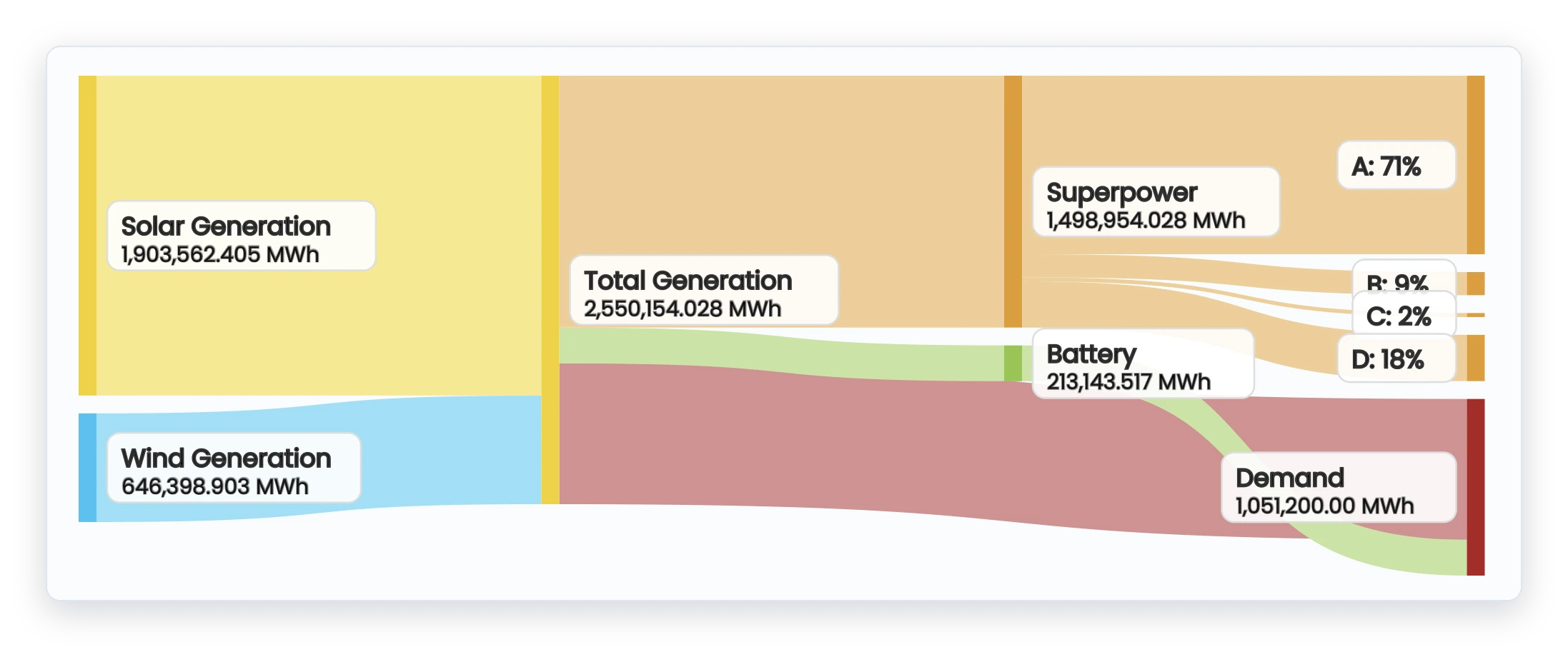
Build a solar, wind, and battery (SWB) system to cover a region's electricity demand and the cheapest design routinely generates 2 to 4 times that volume at near-zero marginal cost. We call this surplus Superpower.

Most operators react by selling the surplus on the open market. That is leaving the value on the table.

The deeper move is to co-locate the industrial processes that need cheap energy, water, and heat, and feed them with Superpower. The economics flip: instead of selling kilowatt-hours, you sell the things that abundant energy lets you produce.

Three examples of the shape

An SWB system powering a data center, with the data center's waste heat routed into precision fermentation or desalination. Multiple high-value outputs from one capital base.

An SWB system powering vertical farming co-located with desalination. Food, water, and energy independence as a single integrated system.

An SWB system powering mineral processing and refining co-located with the mining operations themselves. Value-added refining captured locally, sovereign control over the supply chain, and energy independence from one integrated footprint.

Why this matters now

Killer Combos change the kind of business you can run on a piece of land. They change the rate at which a region can lift its productive capacity. They change which capital allocations make sense over a 20-year horizon. Janus is the system that lets you model them.

07 How we work with clients

Every engagement starts with an Audit.

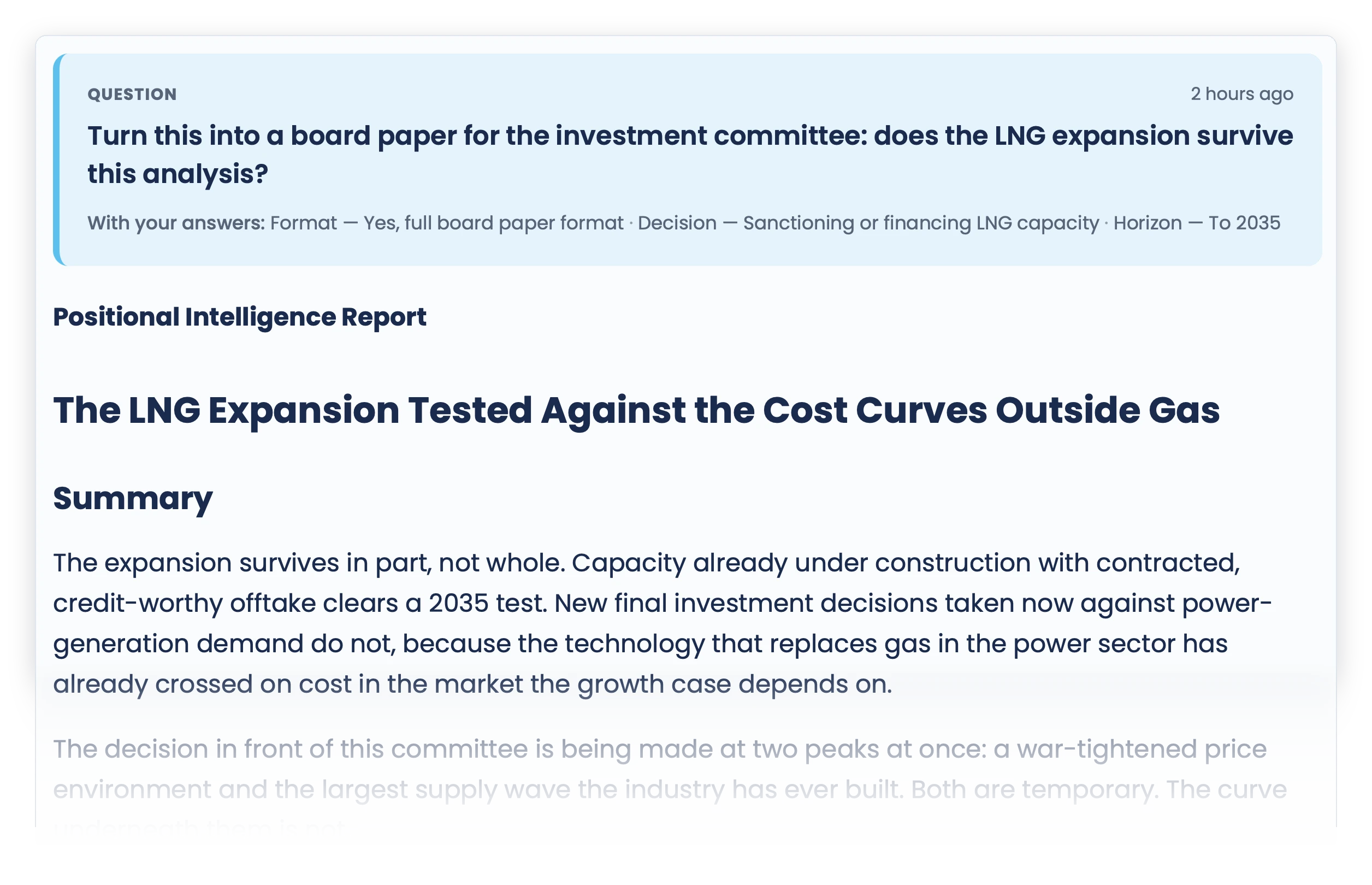
Disruption Economics is not generally well understood, and the translation work is critical to a useful outcome. Every engagement begins with an Audit: a managed, expert-led process that configures Janus to your context, transfers the thinking to your team, and produces a board-ready strategic output.

  1. 01 Configure We bring your data, your existing capital plans, your geographic context, and your sector-specific inputs into Janus. The models speak to your situation, not a generic one.
  2. 02 Analyze Cost curves, collision detection, scenario modeling, killer combo identification, and the strategic recommendations that fall out of them. Sensitivity analysis on the assumptions you are most worried about.
  3. 03 Transfer A working session with your team to walk through the analysis and install the framework. The point is not to hand over a report. The point is to give your team the GPS, so the work continues beyond the engagement.
  4. 04 Deliver You leave the engagement with an expertly configured Janus environment your team operates day-to-day. Run new scenarios, test assumptions, generate board-ready scenario maps, financial models, and narrative slides on demand as the situation evolves. Strategy stops being an annual artifact. It becomes a living capability.
Transfer is the step competitors usually skip. The point is not to hand over a report. The point is to install the GPS so the work continues beyond the engagement.
08 Who Janus is for

Eight kinds of strategist, one platform.

The disruption is so cross-cutting that a useful platform has to serve very different kinds of strategist. Eight in particular.

Asset owners and institutional investors

Stop betting against the laws of physics. Identify your stranded asset exposure and the new value being created.

Industrial and energy incumbents

The linear five-year plan is a recipe for bankruptcy. Convert strategy from static plan to dynamic GPS.

Regional governments and indigenous groups

Do not be a customer of the new economy. Be the owner of it.

Public sector strategy units and central banks

National security in this decade is a function of system dynamics. Cross-sectoral or left behind.

Development agencies and IFIs

Stop funding the 20th century. Map the path for nations to skip legacy infrastructure and build sovereign resilience.

Philanthropic organizations

Linear grants solve symptoms. Systemic intelligence solves root causes.

Data center and compute operators

Superpower as the unbeatable moat. 24/7 base load plus near-zero marginal cost surplus.

Emergent technology founders

Third-party validation of when and how fast, grounded in the physics of disruption rather than market noise.

09 Start the conversation

Every engagement begins with a conversation.

We will help you scope a Disruption Audit that fits your context, your sector, and your most pressing question.

Or jump straight to a sector
30 minutes. No fee. No obligation.